Common Road Test Mistakes in British Columbia
Many people fail the road test not because they are bad drivers. Very often, the real reason is not fully understanding Canadian driving rules and what the examiner expects to see during the test.
Another important factor is stress. During the test, it’s important to focus not on what the examiner is doing, but on the road: scanning traffic, reading signs, following the rules, and making calm, safe decisions.
Your ability to stay calm and manage stress during the road test can be one of the biggest factors in passing successfully.
I hope this content helps you feel more prepared, more confident, and makes your road test a little easier.
Common Road Test Mistakes
Speed — The Number One Mistake
Many people fail the road test because of speed.
Some drivers go too fast and simply follow the flow of traffic. Others drive too slowly, especially in residential areas.
In British Columbia, if there is no other posted sign, the default speed limit is 50 km/h. This applies not only to major streets. Even in many residential neighbourhoods, the limit is still 50 km/h unless another speed limit is posted.
There is no rule that says you must always drive 30 or 40 km/h in residential areas.
But it’s important to understand that 50 km/h is for good road conditions. If the street is narrow, visibility is limited, there are parked cars, children, curves, or other hazards, the driver should reduce speed accordingly. Sometimes that means 45 km/h. Sometimes 40. Sometimes even less. The key is not to drive automatically too slowly or too fast.
Another common mistake during the road test is unnecessary slowing down before intersections.
Many drivers slow down where there is no real reason to do so. Usually this happens for two reasons: either people bring driving habits from their home country, or they are not fully confident about right-of-way rules and who must yield.
As a result, drivers begin slowing down even when they are on the main road and have the right-of-way.
Of course, there are situations where reducing speed is necessary — for example, at intersections with limited visibility where a pedestrian could suddenly appear.
But in most situations, if visibility is good and there is no danger, intersections should be driven through confidently and without unnecessary hesitation.
The examiner wants to see that you understand the speed limit, notice road conditions, and can choose the correct speed for the specific situation.School Zones and Playgrounds
Even if someone has studied the rules, confusion about school zones and playground zones is extremely common.
One of the most common mistakes is automatically slowing down whenever drivers see a school or playground sign.
It’s important to understand: not every school or playground sign automatically means a 30 km/h speed limit.
If you see a “School” or “Playground” sign but there is no speed limit sign underneath it, that sign is simply warning you that there is a school or playground nearby.
By itself, that sign does not require you to slow down to 30 km/h.
If you suddenly slow down for no reason, the examiner may think you do not fully understand the rules.
If there is a 30 km/h speed limit posted underneath the sign, it must be followed very carefully.
If the school zone sign clearly states a maximum speed of 30 km/h, you must not drive above that speed limit even a tiny bit. Speeding in a school zone can result in an automatic fail on the road test.
And it’s important to pay attention to:
- what hours the zone is active;
- what days it applies;
- whether it applies during summer break;
- whether the limit is permanent.
Many people look only at the main sign and forget to read the information underneath.
Another common mistake is slowing down only after entering the zone.
During the road test, your speed should already be reduced BEFORE the sign, not after it.
It’s also important to understand where the zone ends.
Many drivers:
- either speed up too early;
- or continue driving 30 km/h for too long.
The examiner wants to see that the driver understands:
- when the restriction begins;
- when it ends;
- and when it is safe to return to the normal speed limit.
One more thing: people often confuse real school zones and playground zones with regular yellow warning signs.
It’s important to know exactly what school zone and playground signs look like.
I explain this in more detail on my YouTube channel.
↑ Back to topShoulder Check
In Canada, examiners pay very close attention to shoulder checks — checking your blind spot over your shoulder.
For many drivers, this becomes one of the main reasons for losing points.
A shoulder check is not just “for the test.” It is genuinely important for safety.
On Canadian roads, the following can suddenly appear beside your vehicle:
- cyclists;
- electric scooters;
- e-bikes;
- pedestrians rushing to cross the street.
And very often, they move faster than drivers expect.
Shoulder checks are especially important:
- before right turns;
- during lane changes;
- when pulling away from the curb;
- when leaving a parking spot;
- during any sideways movement of the vehicle.
Many drivers think looking in the mirrors is enough.
But the examiner wants to clearly see a head turn.
The examiner needs to see that you are genuinely checking your blind spot, not just pretending to do a shoulder check.
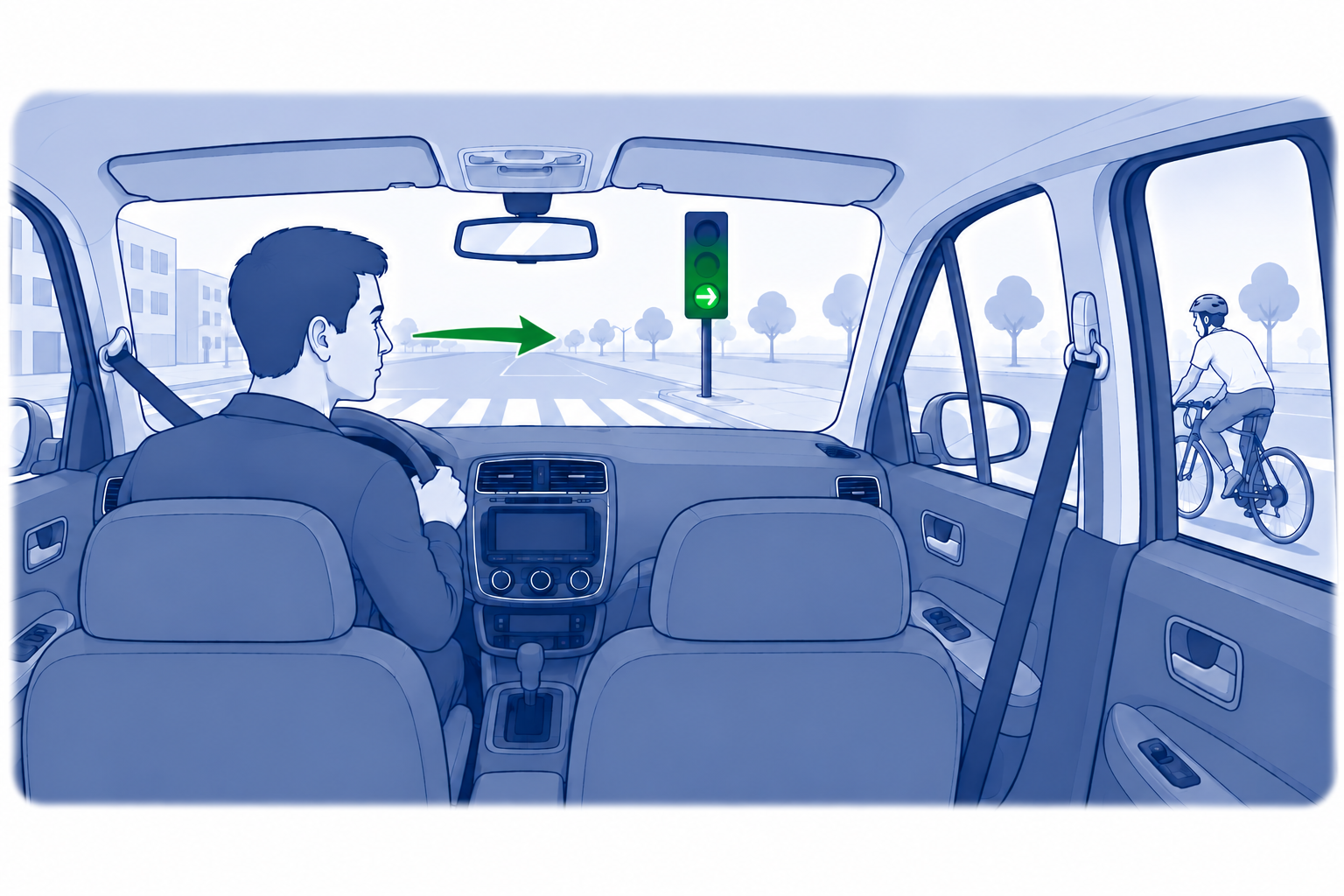
A shoulder check should be done BEFORE the manoeuvre, not at the same time as turning or changing lanes.
That means:
- you are ready to make the manoeuvre;
- but the check is done slightly before;
- so you still have time to react if someone is in your blind spot.
STOP Sign — The Stop Must Be Complete
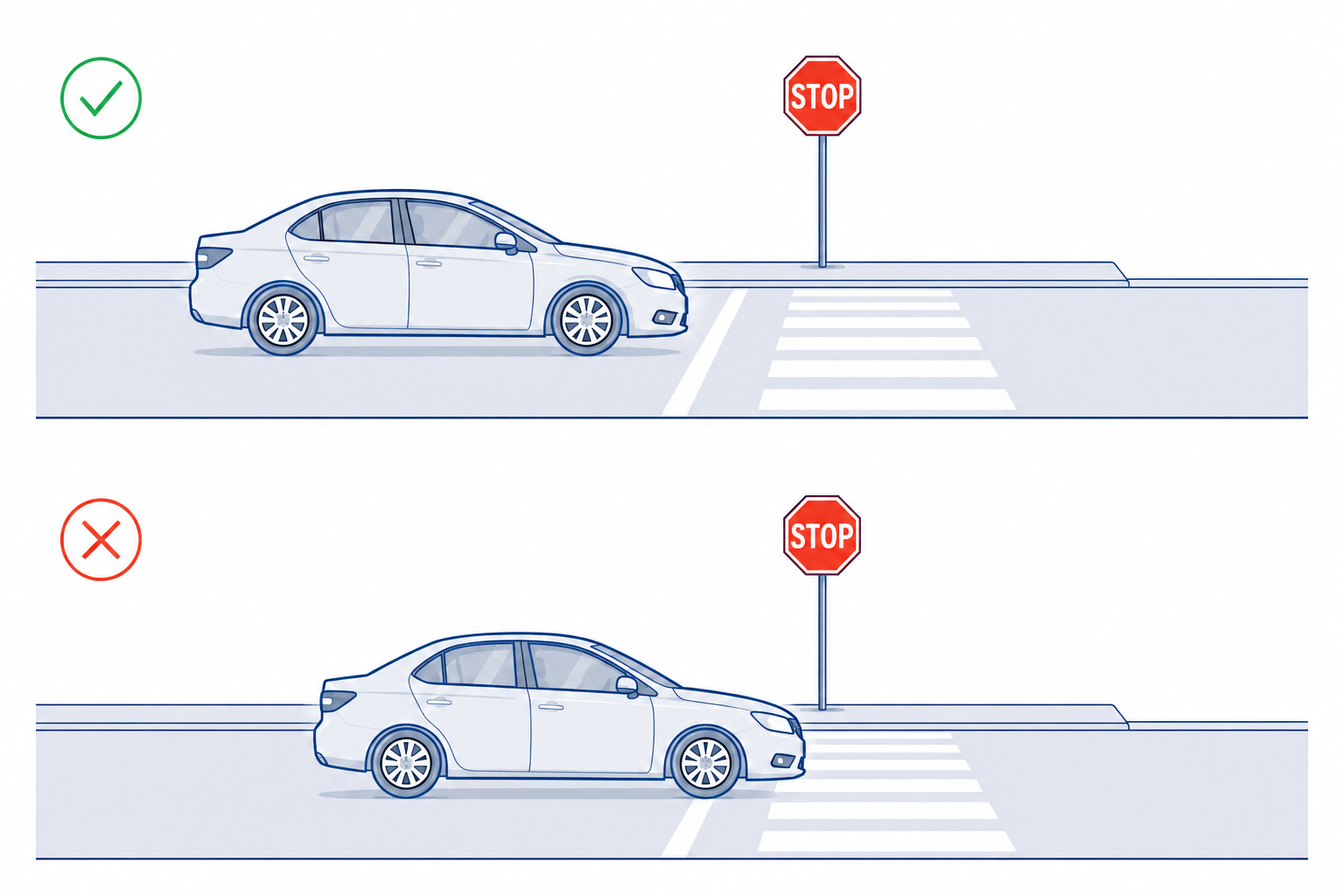
One of the most common mistakes on the road test is not making a complete stop at a STOP sign.
Many drivers approach the intersection, see that the road is clear, and simply roll through slowly without fully stopping.
On the road test, this is considered a mistake.
A STOP sign requires a complete stop, even if:
- the road is empty;
- there are no other vehicles;
- visibility is excellent.
The vehicle must come to a full stop and remain motionless.
The vehicle position is also very important.
The examiner watches carefully to see exactly where you stopped.
The front bumper of the car must stop BEFORE the stop line and must not cross it.
Many drivers mistakenly think the wheels should stop at the line.
In reality, you should use the front bumper as your reference point.
Another common mistake is that people start counting seconds in their head before the car has fully stopped.
But the point of a STOP sign is not to “stand there” for a specific number of seconds.
There is no rule that you must wait exactly 2 or 3 seconds.
The examiner wants to see something else:
- that the vehicle truly came to a complete stop;
- that you clearly established the stop;
- and only after that began checking the intersection.
The examiner will also watch how you scan the intersection.
It is not enough to just quickly turn your head.
It’s important to show that you actually:
- looked both ways;
- assessed the situation;
- made sure it was safe to proceed.
If your scanning looks too quick or not thorough enough, the examiner may consider the manoeuvre unsafe and mark it as a mistake.
 ↑ Back to top
Intersections, Turns, and Traffic Lights
Left Turns
Many drivers lose points specifically during left turns.
Most of the time, the problem is not the turn itself, but misunderstanding the rules and traffic light signals.
In British Columbia, there are several different types of traffic lights for left turns.
Drivers often get confused:
- when they can go;
- when they must yield;
- and who exactly they must yield to.
Because of this, drivers begin to hesitate, brake at the last second, or make the wrong decision.
I explain the different types of left-turn traffic lights in more detail on my YouTube channel.
Another very common mistake is taking the wrong turning path.
Many drivers cut the corner during a left turn.
On the road test, this is considered a mistake.
A left turn should be done calmly and along the correct path, without cutting across the intersection.
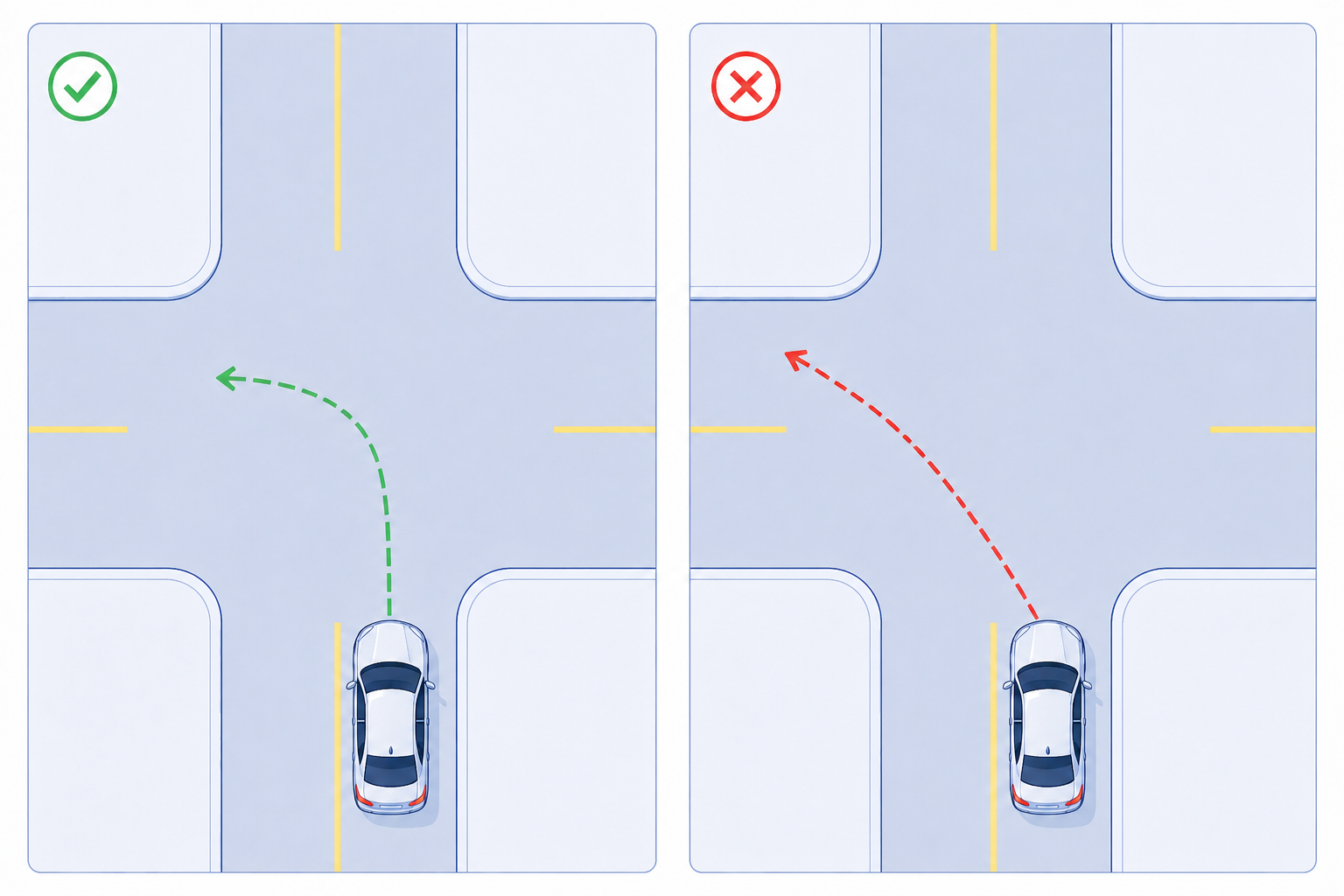
It’s also important to remember: a left turn is usually made:
- from the far-left lane;
- into the far-left lane.
Unless signs or road markings show otherwise.
Very often, drivers pull up too close to the vehicle ahead while waiting to turn left.
Only one vehicle should be in the intersection waiting to complete a left turn.
The second vehicle should wait behind the stop line.
Otherwise, you may end up in the intersection on a red light and not have enough time to finish the manoeuvre safely.
The position of the car in the intersection also matters.
Many drivers:
- either move too far forward;
- or, on the other hand, barely move forward at all.
The car should be positioned so that:
- your intention to turn is clear;
- you have a good view;
- and you do not block oncoming traffic from making a left turn.
One more very important point: while waiting to turn left, your wheels should stay straight.
Do not turn them to the left ahead of time.
If someone hits your car from behind at that moment, a vehicle with turned wheels can be pushed directly into oncoming traffic.
The examiner wants to see that you:
- understand traffic light signals;
- assess the situation correctly;
- position yourself confidently in the intersection;
- and complete the left turn calmly, safely, and without rushing.
Right Turn on Red
For many drivers, this rule feels unfamiliar at first.
Then the opposite problem happens: people get so used to being allowed to turn right on red that they stop coming to a complete stop.
They start treating the intersection like a yield sign — just slowing down and rolling through.
On the road test, this is a serious mistake.
It’s important to remember: a red light means stop first.
Yes, in British Columbia, right turns on red are allowed in many places.
But only after the vehicle has fully stopped.
If you:
- only slowed down;
- did not fully stop the car;
- or started the turn too quickly —
this can lead to an automatic fail.
A complete stop is not just a box to check.
It gives you time to calmly:
- scan the intersection;
- check for pedestrians;
- see cyclists;
- assess vehicle traffic;
- and notice signs that prohibit right turns on red.
Drivers often miss these signs because they approach the intersection too quickly and do not make a proper full stop.
The examiner wants to see that you:
- fully stopped the vehicle;
- carefully assessed the situation;
- and only then decided to continue driving.
Yellow Traffic Light
Many drivers mistakenly think that if the car can make it through the intersection on a yellow light, then it is okay to go.
On the road test, it does not work that way.
A yellow traffic light means: prepare to stop.
If you have enough time and space to stop safely before the intersection, you should stop.
You should continue through a yellow light only when you are already at the point of no return and stopping safely is no longer possible.
If the examiner believes that:
- you could have stopped;
- but chose to go through the intersection instead —
this will be considered a serious mistake and may lead to an automatic fail.
At the same time, it’s important to understand that hard braking can also be dangerous.
Do not:
- slam on the brakes;
- stop on the crosswalk;
- stop in the middle of the intersection.
These actions can also cause you to fail the test.
The examiner wants to see that you:
- assess the situation ahead of time;
- understand the point of no return;
- and make a calm, safe decision.
Highway Driving
For many drivers, highway driving is one of the most stressful parts of the road test.
One of the most common mistakes is accelerating too slowly when entering the highway. The examiner wants to see that you understand highway speeds, accelerate confidently, and merge safely without interfering with other vehicles.
If the highway speed limit is 90 km/h, you should not merge at 50–60 km/h, even if the road seems almost empty. Your speed should be close to the speed of traffic and close to the posted speed limit.
When exiting the highway, do not brake while still in the highway lane. You should reduce speed after entering the designated deceleration lane.
While driving on the highway, it is also important to keep a safe following distance, avoid staying in other drivers’ blind spots, and plan lane changes ahead of time.
↑ Back to topBacking Up
During parking or any backing manoeuvre, the examiner pays very close attention to how you check the area around the vehicle.
Simply looking in the mirrors or at the backup camera is not enough.
The examiner wants to see an actual physical observation around the car.
Before you start backing up, you need to do a full check around the car, also called a 360° check:
- look back to the left over your left shoulder;
- look back to the right over your right shoulder;
- check what is happening behind the car;
- make sure no one is approaching.
This is especially important because:
- a pedestrian may suddenly appear behind the car;
- a child;
- a cyclist;
- a door of a nearby parked car may open;
- or someone may suddenly step out from behind a parked vehicle.
Even if the car has a backup camera, it does not replace a proper physical check.
The camera is only extra help, not a replacement for observation.
The order of observation is also important.
For example, during parallel parking, the last place you check should be the direction in which the car will start moving.
In other words, right before you start moving, your last look should be in the direction the vehicle is about to move.
↑ Back to topDon’t Rush Around Pedestrians
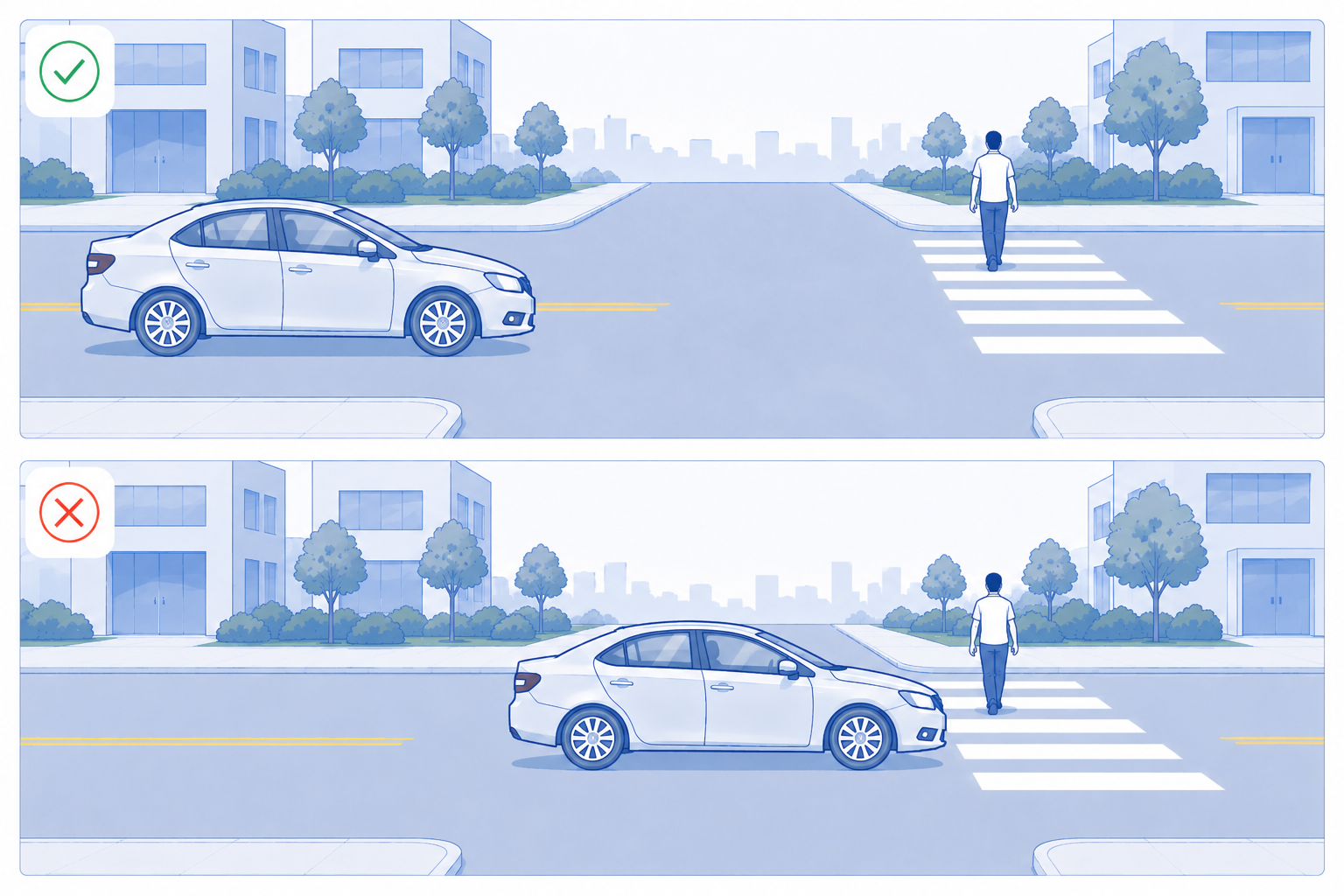
One very common road test mistake is trying to “quickly squeeze through” in front of a pedestrian.
Many drivers think: “The pedestrian is still far away — I have enough time to turn.”
But examiners judge these situations very strictly.
If a pedestrian has started crossing legally, you must yield to them.
When turning, remember:
- if the pedestrian is walking toward you, you need to wait until they have fully crossed the road;
- if the pedestrian is walking in the same direction as you, they must at least clear your half of the road.
Do not try to go just because “there is still space.”
Even if you feel there is enough distance, the examiner may consider that manoeuvre unsafe.
An exception may be a road with a median or safety island in the middle.
If the pedestrian is already on the other side of the divider and is not entering your part of the road, the turn is usually allowed.
It’s also important to remember: in residential areas, pedestrians have the right to cross at any intersection, even if there is no marked crosswalk.
So if you see someone about to cross at the corner of an intersection, you must be ready to stop and yield.
Another common mistake is stopping in the middle of the intersection for a pedestrian.
You should stop BEFORE the intersection, without blocking it.
If the car stops in the middle of the intersection, it blocks other vehicles and creates unnecessary traffic problems.
 ↑ Back to top
Hands on the Wheel
Many experienced drivers eventually get used to driving with one hand.
But on the road test, this is considered an unsafe habit.
The examiner wants to see that you are in control of the vehicle and keeping both hands on the wheel.
Your hands should stay on the wheel:
- while driving;
- during turns;
- when stopped at a red light;
- while waiting at an intersection;
- at a railway crossing;
- and in any other situation when the car is still in drive mode.
Do not:
- steer with one hand;
- turn the wheel with your palm;
- let go of the wheel without a reason.
There is only one exception: when you are backing up and fully turning your body to look through the rear window over your right shoulder.
In this situation, it is acceptable to keep one hand on the wheel.
If the car is in drive mode and you are waiting to continue, your hands should remain on the wheel.
You should completely take your hands off the wheel only when the car is in park.
↑ Back to topExaminer Instructions and Road Signs
This mistake often happens right at the beginning of the test.
People get nervous and do not always listen carefully to what the examiner says.
This can be especially difficult for drivers whose first language is not English.
Before the test begins, the examiner usually explains:
- how instructions will be given;
- when to turn;
- when to change lanes;
- and what to do if the examiner says nothing.
One very important point: if the examiner says nothing, you should not automatically continue straight.
You should continue driving according to the rules, signs, and road markings.
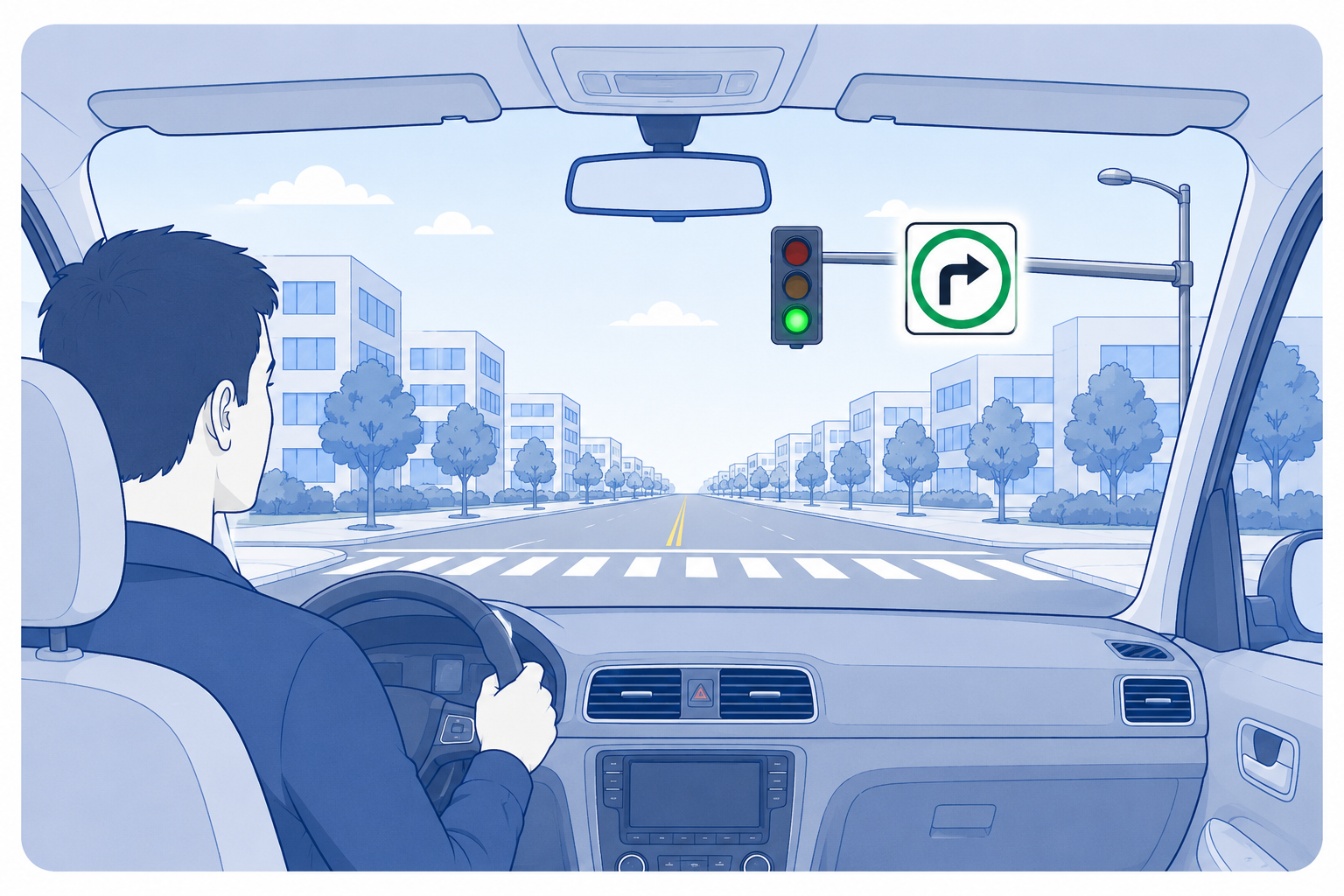
For example, you approach an intersection and the sign shows that you can only turn right.
The examiner may intentionally say nothing because they already told you at the beginning of the test to follow signs and road markings.
In this situation, the driver must notice the sign and turn right.
If you go straight, that will be a mistake.
The same applies to lanes.
If the examiner says, “At the next intersection, continue straight,” you need to understand in advance which lane goes straight.
If your lane is a turn-only lane, you need to change lanes in time and do it safely.
The examiner will not always warn you in advance that your lane is ending or that there is construction ahead.
You need to notice signs, road markings, and the traffic situation yourself.
If you need to change lanes, do it early, smoothly, and safely.
↑ Back to top